Growing massive greenery inside your home brings unprecedented life and vibrancy to modern living spaces. When managing spectacular specimen plants, understanding how to nurture indoor trees effectively is the ultimate key to preventing root rot, leaf drop, and stunted growth.
Cultivating majestic indoor trees requires a shift in how we think about container moisture. Many plant enthusiasts struggle with container moisture dynamics because deep soil beds in heavy ceramic vessels behave differently than standard potted house plants.
Applying the right amount of water at the correct depth makes all the difference for long-term botanical vitality. If you are also interested in smaller-scale indoor gardening, you might want to explore the best herbs to grow on your kitchen windowsill to complement your larger foliage.
Table of Contents
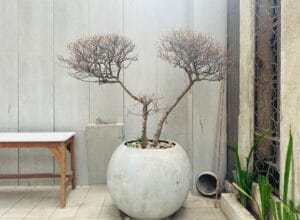
The Unique Challenges of Heavy Ceramic Pots for Indoor Trees
Large ceramic pots are favored for their aesthetic appeal and the stability they provide to top-heavy plants. However, their weight and material properties create specific hurdles for the care of indoor trees.
Ceramic, especially if glazed, acts as a powerful insulator, holding moisture in the center of the root ball long after the surface has dried out. Conversely, unglazed terracotta can wick moisture away from the soil, leading to rapid dehydration in dry climates.
Because these pots are often too heavy to move to a sink or shower, traditional watering can lead to messy floors or standing water in saucers. This standing water eventually causes root rot. Understanding the physics of your container is the first step toward a successful hydration strategy.
If you find your plant is already struggling due to poor drainage, you may need to learn how to revive a dying houseplant before implementing a new watering routine.
Understanding Soil Moisture Dynamics in Glazed vs. Unglazed Ceramic
The material of your ceramic pot plays a massive role in how water behaves inside the container. Glazed ceramic pots are completely non-porous on their exterior walls. This means that moisture can only escape through the top surface of the soil and the bottom drainage hole.
As a result, glazed pots retain moisture for a significantly longer period. This can be highly beneficial for moisture-loving indoor trees, but it increases the risk of overwatering if you are not careful.
Unglazed ceramic pots, such as traditional terracotta, are highly porous. They allow air and water to pass through the walls of the pot. This lateral evaporation helps dry out the soil more evenly, which is excellent for preventing root rot.
However, this means you will need to water your trees more frequently. The outer edges of the soil mix will dry out much faster than the center core, requiring a more deliberate soaking technique.
Choosing the Right Soil Mix for Large Indoor Trees
The foundation of any successful watering routine is the substrate inside the pot. When potting large indoor trees, the choice of growing medium directly dictates how water moves through the container.
Standard potting soils are often too fine and dense for deep containers. They tend to compact under the sheer weight of the soil column, leading to anaerobic zones at the bottom of the pot.
To prevent this, create a custom, highly porous mix that facilitates rapid drainage while retaining adequate moisture. A reliable recipe for these giant plants includes two parts high-quality potting soil, one part coarse perlite or pumice, and one part orchid bark or coco coir chips.
The chunky additives create macro-pores—tiny air pockets that remain open even when the soil is fully saturated. This structural integrity ensures that your indoor trees do not suffer from compacted, oxygen-deprived roots.
Additionally, incorporating a handful of horticultural charcoal can help absorb impurities. It also deters the fungal pathogens that thrive in stagnant, overwatered environments.
The Physics of Water Movement in Deep Pots
Water does not move through a deep pot in a simple, uniform downward path. Gravity pulls water down, but capillary action pulls it sideways and holds it within the tiny spaces between soil particles.
In deep containers, a phenomenon known as a “perched water table” often occurs. This is a layer of saturated soil at the very bottom of the pot that refuses to drain, held there by capillary forces.
Many gardeners mistakenly believe that adding a layer of gravel to the bottom of a pot without drainage holes helps. In reality, this actually raises the perched water table closer to the roots, increasing the risk of rot.
To combat this, always ensure your heavy ceramic pots have functional drainage holes. The transition between different soil textures must be avoided to maintain a continuous, healthy flow of water.
Secret 1: The Perimeter Soak and Drench Technique
Sub-soil soaking ensures that water reaches every single root fiber instead of washing down the sides of dried soil gaps. In large containers, soil often pulls away from the edges of the pot as it dries.
This shrinkage creates “channels” where water escapes without ever reaching the roots. To execute a proper soak, pour water slowly in a continuous circle around the outer perimeter of the container.
Avoid pouring water directly at the trunk base. This slow, deliberate saturation is the golden rule for keeping indoor trees healthy and properly hydrated.
Allow the liquid to seep gradually into the dense growing medium over fifteen to twenty minutes. For mature indoor trees, the soil needs to be saturated until roughly ten percent of the applied liquid flows into the drainage tray.
This process guarantees that hydrophobic dry pockets within the core potting mix fully dissolve and absorb fresh moisture. It also flushes out accumulated salts from fertilizers before they can damage delicate root tips.
Secret 2: Implement Soil Probes and Subsurface Aeration
Determining moisture levels inside oversized planters by checking the top inch of soil is one of the most common care mistakes. Deep containers can remain dangerously wet near the bottom while looking bone-dry on the surface.
Using a wooden dowel or a long moisture probe allows you to check the conditions at the very bottom of the pot. Insert the tool deep into the root zone to get an accurate reading of the moisture gradient.
Furthermore, the soil in large pots tends to compact over time due to the weight of the plant and the volume of the earth. Use a thin bamboo stake to gently poke holes deep into the soil every few months.
This subsurface aeration allows water and oxygen to reach the deep roots of indoor trees, preventing the anaerobic conditions that lead to fungal infections.
According to the University of Minnesota Extension, proper aeration and even moisture distribution are critical for maintaining the health of large containerized plants.
Secret 3: The Siphon and Wick Method for Heavy Containers
When dealing with exceptionally large indoor trees that cannot be moved, the siphon or wick method can be a lifesaver. This involves using a cotton or nylon rope that connects a reservoir of water to the soil.
One end of the wick is buried deep into the pot (ideally during repotting, but it can be inserted via a probe), and the other end sits in a bucket of water placed slightly higher than the pot.
This method provides a slow, consistent capillary action that keeps the soil moisture levels stable without the risk of a sudden deluge.
It is particularly effective for species that prefer consistent moisture, such as Ficus lyrata or large Ferns. This slow-drip approach mimics natural rainfall and prevents the soil from becoming compacted by heavy pouring.
Secret 4: Managing Drainage Without Moving the Pot
The biggest fear with deep watering is the overflow. To manage this in heavy ceramic pots, use a “turkey baster” or a small hand pump to remove excess water from the saucer after a deep drench.
Never let the pot sit in standing water for more than 30 minutes. If your pot is so heavy that it sits directly on the floor without a saucer, consider using a “pot-in-pot” or cachepot system.
In a cachepot setup, the tree lives in a plastic nursery liner with plenty of drainage holes, which is then placed inside the decorative ceramic pot.
You can add a layer of gravel or “pot feet” at the bottom of the ceramic pot to ensure the nursery liner never touches the runoff water. This allows for deep watering of large indoor trees while keeping the heavy outer vessel clean and dry.
Secret 5: Seasonal Adjustments and Humidity Syncing
Watering is not a “set it and forget it” task. During the winter months, most trees enter a period of dormancy where their metabolic rate slows down.
During this time, the frequency of deep watering should be reduced significantly. However, the dry air from indoor heating can cause the soil surface to dry out prematurely.
This surface dryness is particularly common with sensitive indoor trees like the Ficus lyrata. To balance this, focus on increasing ambient humidity rather than adding more water to the soil.
Grouping plants together or using a humidifier can reduce the transpiration rate of the leaves, meaning the plant needs less frequent deep watering. Always check the moisture levels at the root zone before deciding to water, regardless of the season.
How to Use a Moisture Meter Correctly in Deep Soil
A moisture meter is an invaluable tool for managing large pots, but it must be used correctly to avoid false readings. Always insert the probe at least two-thirds of the way down into the pot to reach the active root zone.
Do not leave the meter in the soil permanently, as this will corrode the metal tip and ruin its accuracy. Wipe the probe clean with a dry cloth immediately after every single use.
Keep in mind that soil salinity can affect electrical moisture meters. If you use tap water with high mineral content, the meter might read “wet” even when the soil is relatively dry.
Combine your meter readings with the physical feel of the soil to get the most accurate assessment of your plant’s needs.
Species-Specific Watering Needs for Large Indoor Trees
Different species of indoor trees have vastly different hydration requirements. For example, the popular Fiddle Leaf Fig (Ficus lyrata) prefers its soil to dry out slightly between waterings, but demands a thorough drenching when it is time.
The Weeping Fig (Ficus benjamina) is highly sensitive to moisture fluctuations. Sudden changes in soil moisture will cause it to drop its leaves in protest.
On the other hand, the Money Tree (Pachira aquatica) stores water in its swollen trunk. It requires much less frequent watering and is highly susceptible to root rot if kept in soggy soil.
The Dragon Tree (Dracaena marginata) is incredibly drought-tolerant and prefers its deep ceramic pot to dry out almost completely before receiving another drink.
Understanding the specific origin and evolutionary adaptations of your tree will help you tailor your watering routine perfectly.
How Often to Deeply Water Indoor Trees
Determining the exact schedule for watering indoor trees depends on a multitude of environmental variables, including ambient light, room temperature, and container material.
There is no universal calendar schedule that works for every home. Instead of watering on a strict weekly basis, train yourself to read the physical cues of both the soil and the plant.
For most large specimens, a deep watering session is required only when the top three to four inches of soil have dried out completely.
During active growth phases in spring and summer, these indoor trees will consume water at a much faster rate as they push out new foliage.
Conversely, during the shorter days of winter, their water consumption drops dramatically. By using a soil moisture meter or the wooden dowel method regularly, you can track these shifts and avoid the common pitfall of overwatering.
Remember, it is always safer to underwater slightly than to keep the root system constantly submerged in soggy soil.
Troubleshooting: Signs of Improper Hydration
Even with the best techniques, it is important to monitor your plant’s reaction. Overwatering typically manifests as yellowing lower leaves, a soft or mushy trunk base, and a distinct “swampy” smell from the soil.
Underwatering, on the other hand, usually results in crispy brown leaf edges, drooping branches, and soil that has pulled away significantly from the sides of the ceramic pot.
If you are looking for more resilient options that require less frequent attention, you might consider adding some low-water plants to your collection.
These can serve as excellent companions to your larger trees, filling in the gaps of your indoor jungle without adding to your watering workload.
Maintaining thriving indoor trees is a journey of observation and patience. By mastering the art of deep watering in heavy ceramic pots, you ensure that your home remains a lush, green sanctuary for years to come.
Remember that every plant is an individual. Adjust these secrets to fit the specific needs of your tree and the unique environment of your home.